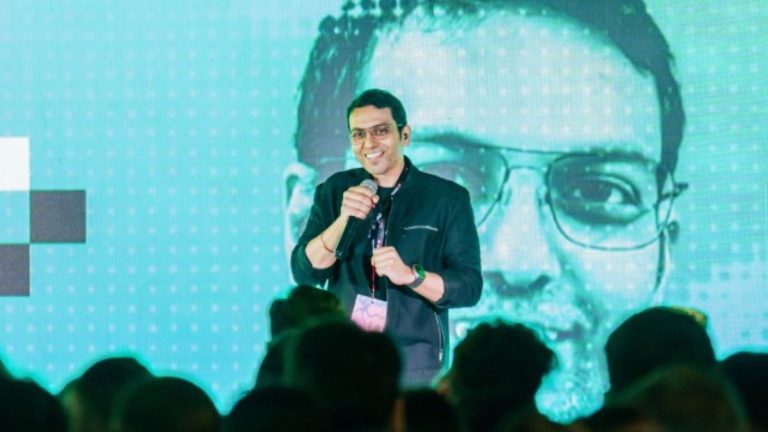
Design within the contemporary context operates at the intersection of psychology, ethics, technology and business strategy, and is no longer restricted to visual aesthetics alone, said Shayak Sen, Head of Design at Myntra, during a session at Ahmedabad Design Week that kicked off on Friday.
Addressing the session at Hutheesing Visual Arts Centre on “The Dopamine Engine: How E-commerce Designs for the ‘Add to Cart’ High”, Sen explained how designers influence decisions that shape consumer behaviour and business outcomes.
“The role of the designer is not just to be an executioner. They are actually sitting side by side with the product or business teams and thinking right at the start how the experience has to be built,” he said.
Sen traced the evolutionary trajectory of the profession, stating how design has repeatedly adapted with technological shifts.
“When digital products started scaling, there was a requirement for a new breed of designers who could understand visual communication but also manage it with technology,” he said. He added that artificial intelligence is driving a similar transition. “With AI coming in, we are again seeing new kinds of interactions and new ways of thinking about form factors.”
Sen believes that design stagnates when it remains locked into familiar patterns.
“If you stay with one kind of design for long, it gets compromised,” he noted.
Story continues below this ad
Speaking about AI, Sen explained how interfaces are likely to become more fluid and adaptive. “The interface is now going to get virtualised based on what kind of user group you are. And India is a very heterogeneous country. The same kind of UI (User Interface) cannot work,” he said. “When I say UI, there are so many parameters involved — typographic density, contrast, colour vibrancy. These choices for an aspirational user and a non-aspirational user are going to be very, very different.”
Sen also warned against rigid frameworks that could hinder creativity within processes. “Processes are instruments. There is no absolute truth — there are only local truths,” he said. Referring to design thinking, he stated, “Design thinking was extremely useful when it was introduced. Maybe it is not that useful now. Maybe it will be useful tomorrow.”
He also explained how creative insights frequently emerge beyond the bounds of structured workflows. “The best design ideas don’t come when I am actually following a process. It comes when I am sitting with the problem for a long time,” Sen said. “You have to live with the problem and believe there is something meaningful to solve.”
Addressing ethics within e-commerce design, Sen said that the challenges have intensified with AI-driven systems. “In an open market, it’s always going to be difficult to have responsible design,” he said. He added that designers carry moral responsibility even while dealing with commercial pressures. Referring to regulatory scrutiny of dark patterns, he said, “These are practices where designers can really contribute. We go through excessive audits.”
Story continues below this ad
Mechanisms such as urgency cues, price anchoring and stock notifications are standard in e-commerce. These mechanisms, Sen said, must be grounded in truthful information. “If you create false urgency, that becomes a dark pattern. We don’t do that at Myntra,” he said.
He highlighted the role of behavioural psychology and personalisation in shaping a satisfactory user experience. “The entire UI and content that you see is highly personalised,” Sen said.
For designers concerned about being overwhelmed by AI tools, Sen pointed out that the issue is not technical difficulty. “Learning tools is not the hardest part. Tools are actually easy,” he said. “What overwhelms people is knowing how much can be done and not knowing where to start.”
For students entering the profession, Sen advised against reacting only to current trends. “If you are responding to what you are seeing right now, it’s already peaking,” he said. He emphasised first-principle thinking, curiosity and adaptability, adding that designers must be willing to challenge internal priorities. “Design is the only function that can own the user’s point of view strongly,” Sen said. “You have to keep fighting for the customer’s voice.”
Story continues below this ad
Ahmedabad Design Week is being held at Karnavati University from January 30 to February 1, bringing together designers, industry leaders and academics to discuss the intersection of design and artificial intelligence across sectors.
(Nishant Bal is an intern at the Ahmedabad office of The Indian Express)
